
In the 21st century the knowledge-based economy, new technologies, artificial intelligence and globalization put emphasis on the needs to employees’ upskilling and reskilling. The emergence of new competences has become a key concept in the labour market. In general, the majority of employees should be able to acquire new practical skills so as to be able to change their job as well as career.
Then, it is worth noticing that a range of new competences acquired in all sectors of the formal education system can empower people to improve the EU economy and break down communication barriers in particular in the group of disabled people. According to RFDC, this process covers the formal systems from “pre-school through primary and secondary schools to higher education”. What is more, the EU supports the non-formal and informal learning, which coexist on the parallel routes. This diversified path can be available in-person, online, via mobile applications, etc. as well as through supplemental resources such as textbooks, virtual reality applications, multimedia, and so on.
Considering the wide range of possibilities, the learning environment should be approached in a holistic way. Accessibility plays a key role in this diverse sector and should be treated as an integral part of the teaching and learning process. Therefore, the syllabi of formal and non-formal courses, workshops, and training programmes should combine traditional subject areas with elements of digital accessibility. For example, art departments can include topics such as colour contrast ratios and colour-blindness in their curricula, IT departments can integrate WCAG guidelines into programming courses, and foreign language courses can address the translation of alternative text.
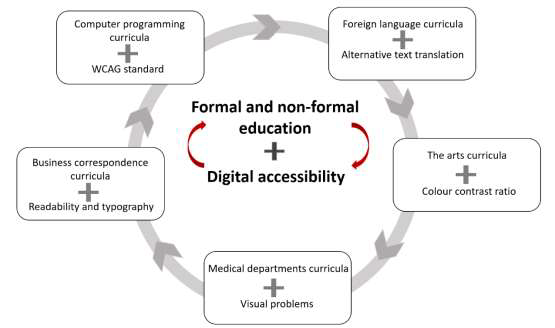
This panel invites you to share your ideas on how courses, workshops, training sessions, and classes, both in formal and non-formal education, can promote digital accessibility. We encourage you to present holistic syllabi that integrate accessibility principles into a wide range of disciplines.
Presentations may explore, but are not limited to, the following topics:
- Integrating accessibility into website localization
- Accessibility within the translation process
- Teaching colour contrast in art and design courses
- Using AI to support the translation of alternative text
- Creating accessible documents for business communication
- Balancing typography and accessibility in marketing
Chairs

Izabela Mrochen, MultiAccess Centre